
WHO Al Hudaydah Operation – Yemen: Situation Report #2, 24 – 30 June 2018
Situation update:
- Conflict and port status: Fighting has decreased in Al-Hudaydah City, Zabid and Bayt Al-Faqiah districts, however there are reports of intermittent shelling and airstrikes. Several city roads remain closed to civilians. Roads surrounding Hudaydah are obstructed by berms or trenches and some are impassible. The port remains operational.
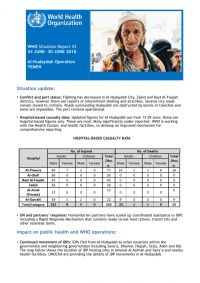
- Hospital-based casualty data: Updated figures for Al-Hudaydah are from 13-29 June; these are hospital-based figures only. These are most likely significantly under-reported. WHO is working with the Health Cluster, and health facilities, to develop an improved mechanism for comprehensive reporting.
- UN and partners’ response: Humanitarian partners have scaled up coordinated assistance to IDPs including a Rapid Response Mechanism that contains ready-to-eat food rations, transit kits and other essential items.
Impact on public health and WHO operations:
- Continued movement of IDPs: IDPs fled from Al-Hudaydah to other locations within the governorate and neighboring governorates including Sana’a, Dhamar, Hajjah, Taizz, Aden and Ibb. The map below shows the location of IDP hosting sites in Amanat Al Asimah and Sana’a and nearby health facilities. UNOCHA are providing the details of IDP movements in Al-Hudaydah.
- Damage to WASH systems: Repairs to the water supply pipes and sewage systems in Hudaydah City are ongoing to minimize the risk of waterborne diseases including. The district of Al-Hali, located in Hudaydah city, has the highest number of reported suspected cholera cases. Limitations in sanitary facilities in some IDP sites s are being reported, further increasing the risk of cholera transmission.
- Threat to hospital buildings/structures: Two of Hudaydah city’s main public hospitals, Al Olofi and Al-Thawra, are at increased risk of damage if the fighting continued to progress towards the city. Electricity is unavailable in most areas of Hudaydah City, endangering operations of health facilities.
- Limited access to provide and receive health care: In some districts, the fighting is limiting access to the population to provide health care, as well as preventing health care workers from reporting for duty for safety and security reasons.