
Yemen: Protection Cluster Update (June 2018)
SITUATION OVERVIEW
The military escalation to capture al-Hudaydah and its port has reached decisive stages, with potentially catastrophic consequences for civilians. As a result, the physical safety of civilians is being increasingly threatened by indiscriminate attacks as fighting spills into al-Hudaydah city, while hostilities remain active along other frontline locations such as Marib, Taizz and al-Bayda. More than ever, ensuring protection of civilians remains paramount, as does addressing the growing protection needs for the conflict-affected and displaced population of Yemen.
Protection of Civilians
Fighting in Yemen escalated dramatically in late-May, when the frontlines in al-Hudaydah began to make rapid advances to the edge of al-Hudaydah City. As documented by OHCHR, the governorates most affected by casualties in the first five months of 2018 were Sa’ada (19%), alHudaydah (16%), Taizz (15%) and Sana’a and Amanat alAsimah (14%). According to the Protection Cluster’s Civilian Impact Monitoring Project, a total of 844 incidents of armed violence with civilian impact were recorded in the last six months in monitored governorates, resulting in 1,828 civilian casualties, 26% of which were women and children. Illustrating the vast insecurity facing the conflictaffected population, civilians were killed and injured most frequently inside their homes (27%), at public services and infrastructure sites (16%), including main roads and governmental compounds, and in cars or buses (11%). A total of 2,308 civilian structures were damaged, illustrating the far-reaching damage caused to civilian structures by armed violence. Houses were the most frequently impacted structures, as well as civilian infrastructure including main roads, bridges, telecommunication infrastructure, governmental compounds, ports, and airports. Other structures used by civilians were also damaged, including food and water infrastructure, education centers, healthcare facilities, aid, protected sites, and prisons.
Internal Displacement
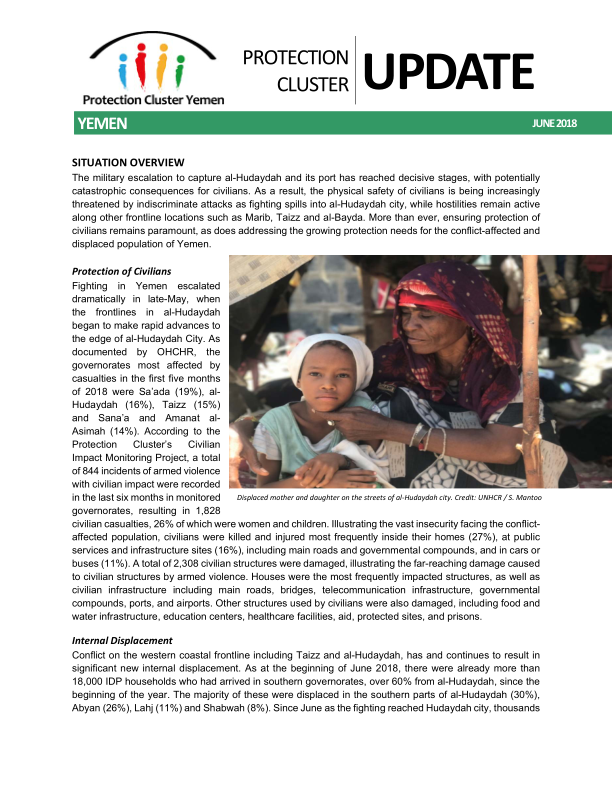
Conflict on the western coastal frontline including Taizz and al-Hudaydah, has and continues to result in significant new internal displacement. As at the beginning of June 2018, there were already more than 18,000 IDP households who had arrived in southern governorates, over 60% from al-Hudaydah, since the beginning of the year. The majority of these were displaced in the southern parts of al-Hudaydah (30%), Abyan (26%), Lahj (11%) and Shabwah (8%). Since June as the fighting reached Hudaydah city, thousands Displaced mother and daughter on the streets of al‐Hudaydah city. Credit: UNHCR / S. Mantoo of internally displaced (IDP) households having been displaced within al-Hudaydah, as well as to Ibb, Sana’a and Aden, with the numbers increasing daily. Together with other humanitarian response partners and in coordination with the Rapid Response Mechanism, Protection Cluster partners are working in humanitarian service points and transit sites to identify vulnerable and persons with specific needs and follow-up with emergency protection assistance and services.